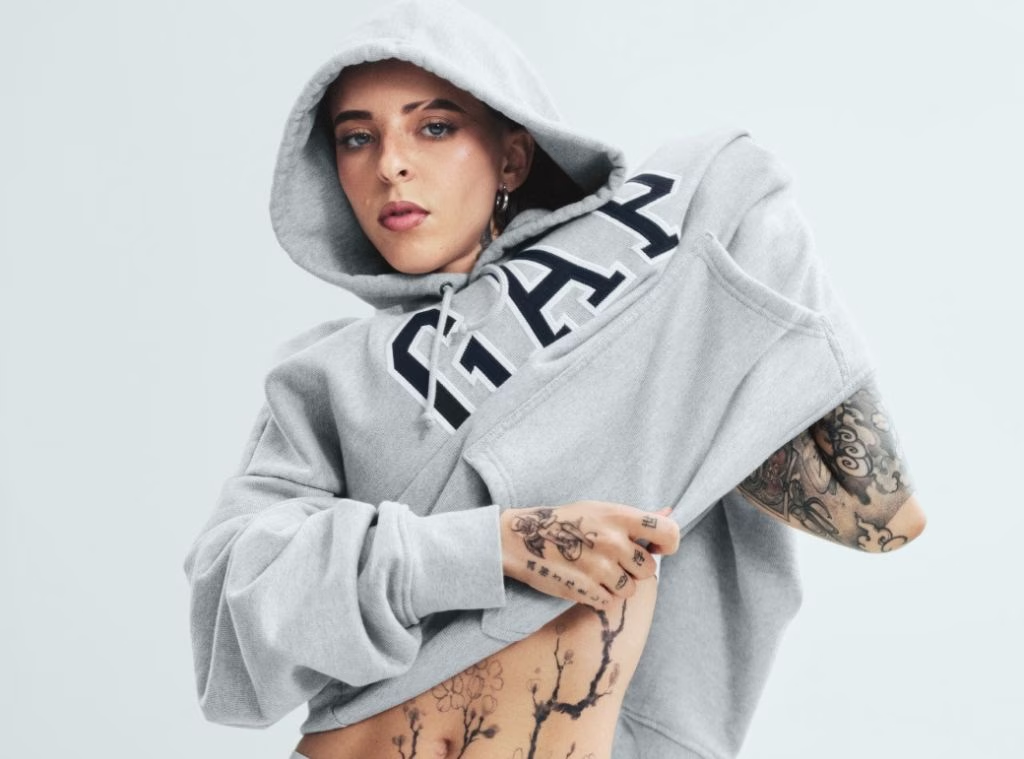
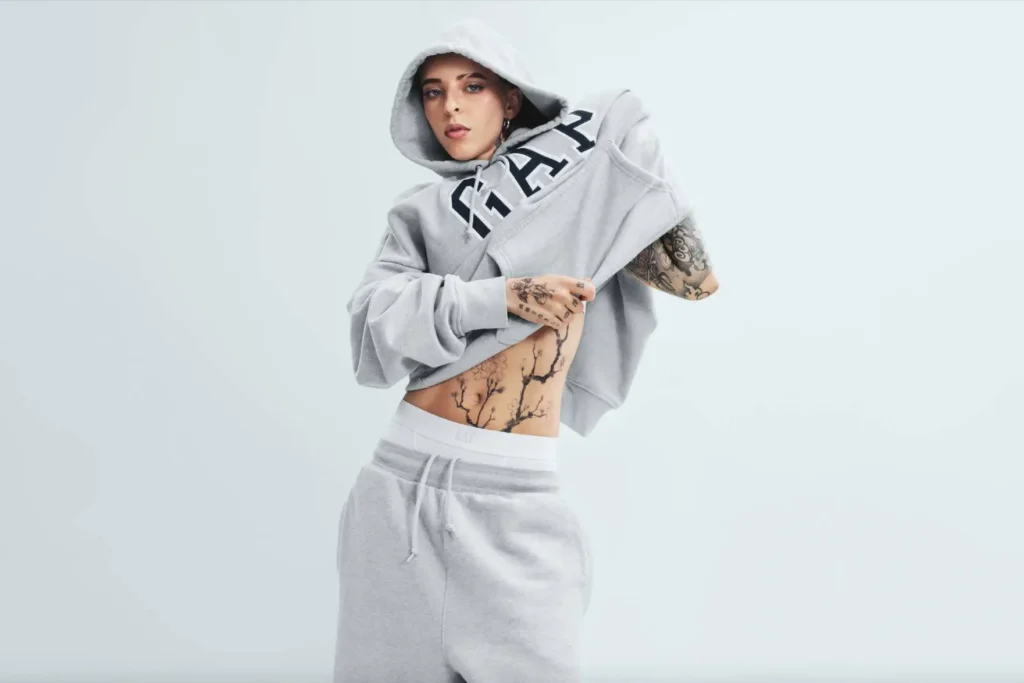
GAP’s latest campaign featuring Young Miko is a genuine triumph. As the brand’s first-ever Spanish-language ad, it features a rhythmic reimagining of her hit track “Wassup” (re-titled “Sweats Like Us”) and a cast of 26 dancers. GAP is doing exactly what a global brand should: leaning into the “power of the peso” and acknowledging the undeniable global dominance of Latine culture.
Mainstream outlets like Billboard and Elle have been quick to crown the moment a milestone for “Latina representation.” Yet, as the dust settles, a glaring omission remains in the media’s celebratory echo chamber. While the press is comfortable discussing her Puerto Rican heritage, they are noticeably glazing over her lesbian identity.
Not just any lesbian, but arguably the most famous Spanish-speaking lesbian in the world today. By sanitizing her identity into a palatable aesthetic, mainstream coverage fails to grasp the intersectional reality of Miko’s rise and the profound subversion she represents in the Latine music industry.
The most authentic glimpse of Young Miko’s power doesn’t come from sanitized press releases, but from her own unfiltered voice. In Interview magazine, she famously described her sets as a “Lesbian Thunderdome.” She speaks candidly about her “gay awakening,” citing icons like Lucy Liu and Hayley Kiyoko.
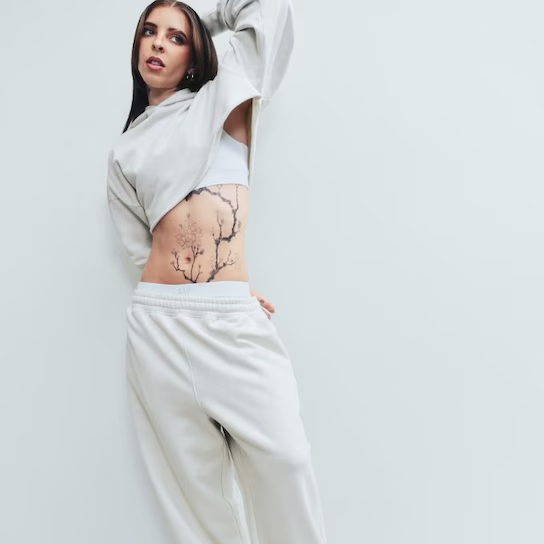
To her fans, Miko isn’t just a queer icon. She is a beacon of lesbian possibility. She represents a version of lesbianism defined by joy, confidence, and absolute dominance in a male-centric field. The GAP campaign, for all its minimalist beauty, places Miko in a sleek, universal void. But Miko is not universal; she is specific. She is a woman who loves women, a former soccer star, and a tattoo artist from Añasco. Her lesbianism is the lens through which she writes her lyrics and the reason her connection with her female audience is so feral and devoted.
As we analyze the “Gap era” of Young Miko’s career, we must demand more from the journalists and cultural commentators covering her. It is not enough to celebrate her “heritage” while ignoring the very identity that makes her a hero to millions of young women.
Young Miko is not a “safe” version of representation. She is a riot of tattoos, Spanish slang, and lesbian swagger. To cover her Gap campaign without naming her lesbianism is to participate in the same erasure that has plagued queer women of color for decades. It is time for the mainstream to catch up to the “Lesbian Thunderdome.” It is time to stop hiding her power behind vague labels and start honoring the intersectional reality of who she actually is.
The Sanitization of the L-Word
To understand how mainstream coverage of the Gap ad fails Young Miko’s intersectional reality, one must look at the language of erasure. In the Billboard profile, Miko is briefly labeled as the “first queer Latina” to front the brand. Elle focuses on her culture and heritage. While these descriptors are factually correct, they function as a linguistic and political softening.
The word “Queer” has been reclaimed as a beautiful, inclusive political identity, but in the hands of corporate media, it is often used to avoid the historical and political weight of the word Lesbian. And to avoid the punitive measures social media sites put on the word as a means of censoring pornographic content.
Being a lesbian in the hyper-masculine, often heteronormative landscape of Latin Trap is a distinct experience from the generalized “queer” experience. It involves a specific navigation of the male gaze, or more accurately, a total rejection of it.
Miko’s music is not “vaguely queer.” It is explicitly lesbian. From her Trap Kitty era to her “Lesbian Thunderdome” sets at Governor’s Ball, she raps about women with a swagger that was previously reserved for men in the genre. When the media ignores this, they aren’t just missing a detail; they are stripping the “Wassup” video of its revolutionary context. The campaign isn’t just a “vibe” it is a lesbian woman taking up space in a world that has historically only allowed women to be objects of desire, never the ones doing the desiring.
The Intersectional Friction of the Gap Campaign
Intersectionality, a term coined by Kimberlé Crenshaw, describes how overlapping identities, such as race, gender, and sexual orientation, create unique modes of discrimination and privilege. Young Miko exists at a high-pressure intersection, she is a Puerto Rican woman, a Boricua, a Spanish-speaker in a global market, a tattoo-covered urban artist, and a lesbian.

The campaign debuts just months after Bad Bunny’s iconic Super Bowl set where digital trolls claimed that only true Americans should be able to perform, despite Bad Bunny and Young Miko both being from Puerto Rico, which is part of the United States.
The Gap campaign is historic because it honors the first two layers of that intersection. By allowing Miko to perform in Spanish, Gap acknowledges the “power of the peso” and the undeniable global dominance of Latine culture. However, the intersectional failure happens when the media treats her lesbianism as a “side dish” rather than the main ingredient.
For a Puerto Rican woman to be out and proud as a lesbian on a global stage is a direct challenge to machismo and traditional Catholic social structures that still exert influence in Latine communities.
When Elle or Billboard frame her as a “shaper of culture” without naming the lesbian culture she is shaping, they are engaging in a form of cultural grazing, taking the “cool” parts of her identity (the tattoos, the baggy clothes, the “tumbao”) while leaving the “difficult” parts behind.
Why Naming Matters
Young Miko being the “first queer Latina” at Gap is a headline. Young Miko being “the most famous out lesbian in the Spanish-speaking world” leading a global campaign is a movement. The latter acknowledges the specific barriers she broke down in the reggaeton world. It acknowledges that she is singing “Wassup” to a woman, and that millions of people are singing those lyrics back to her, normalizing lesbian desire in spaces where it was once invisible.
The media’s neglect of her lesbianism is a strategic choice to keep her “marketable.” It assumes that the word “lesbian” is still too provocative for the general public. But Young Miko has never been about playing it safe. She is a tattoo artist who turned herself into a canvas; she is a rapper who refused to change her style to suit the charts.