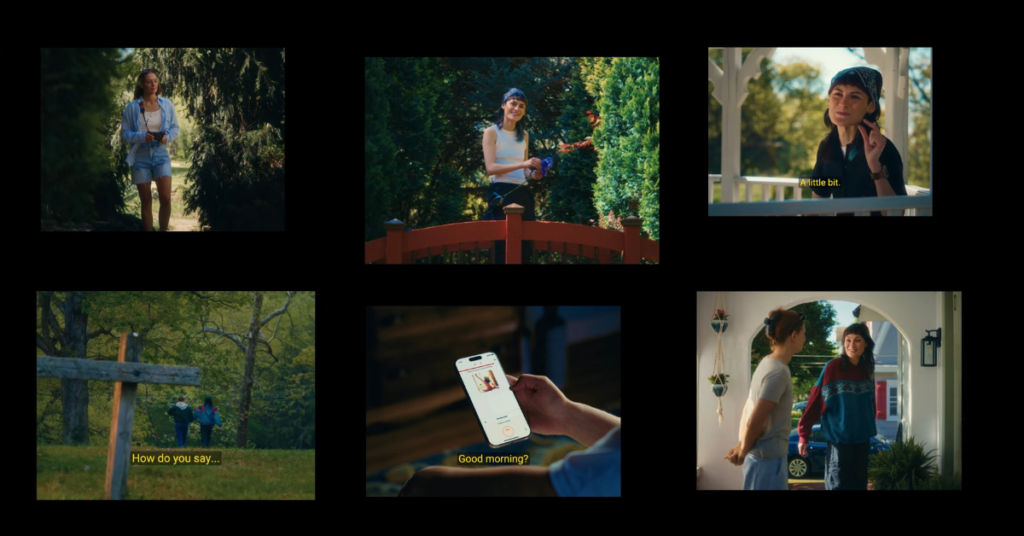
As I watched the latest Duolingo commercial circulating on my feed, I wasn’t met with a manic owl. Instead, I saw something so rare in the wild of mainstream marketing that I actually had to put down my iced coffee: A genuine, domestic, beautifully shot lesbian love story.
The lighting was soft. The chemistry was “I-can-feel-it-through-the-screen” palpable. It was a story about the ultimate romantic labor: learning a partner’s native language to connect with their family. It was tender, it was nuanced, and, most importantly, it didn’t feel like it was trying to sell me a rainbow-colored sandwich in June.
For exactly sixty seconds, I felt a glimmer of hope for the future of corporate advertising. I was ready to give Duo the Owl a standing ovation. With more than 1 million views on TikTok and 1500 crying queer women in the comments, it’s safe to say I wasn’t alone.
And then, I did what any self-respecting journalist does: I checked the credits.
Plot twist: Duolingo didn’t make this advertisement. The “ad” is a spec piece, a creative exercise, a “fake” produced by the absolute geniuses at Pool Girl Studios.
And while I’m obsessed with their talent, I’m also a little bit annoyed. Because once again, the best representation we’ve seen all year came from the free labor of queer creators doing it for the plot without the paycheck they deserve.
The “Wait, This Isn’t Real?” Heartbreak
Why did half the queer internet (myself included) fall for this? Because we are essentially starving.
Most “inclusive” ads follow a very tired, very straight script. You’ve seen them: The Coming Out drama where everyone cries, or the B-roll shots of a pride parade.
Pool Girl Studios did something radical, they treated a lesbian relationship as the default. They didn’t make the ad about being gay; they made it about the universal vulnerability of trying to say “I love you” in a language that isn’t your own.
It captured the queer gaze perfectly because it was made by us. There’s a specific way we look at each other, a specific way we exist in our homes, that a straight creative director at a massive agency just… misses. Every time.
The Duolingo Paradox
The irony here is thicker than the thickest language textbook. If you’ve spent any time on the app, you know Duolingo is actually chock-full of representation.
Inside the lessons, it’s a queer utopia. You’ve got Lin, the chaotic lesbian; Bea, the ambitious bisexual; and Oscar, the gay man who is frankly too sophisticated for all of us. They talk about their dates and their exes with the kind of mundane frequency that makes my cold, cynical heart grow three sizes. Duolingo has mastered unsensationalized normalization within their product.
But there is a massive representation gap between what happens inside an app and what a brand is willing to put on a billboard or a YouTube pre-roll. While the Duo characters are queer in the safety of a French lesson, we rarely see that same energy in their global, high-stakes video campaigns.
The Pool Girl Studios team essentially looked at Duolingo and said, “Hey, your app is already queer—why aren’t your ads?” Then, they went ahead and filmed the answer.
The Rise of the “Fixed It For You” Era
We are living in the age of the “Fix It For You” content cycle. From fan-edits to professional-grade spec ads like this one, queer creators are tired of waiting for permission to exist in the mainstream.
When big brands play it safe, we pick up a camera. We are proving, over and over again, that our stories aren’t “niche” or “risky”—they’re just good storytelling. The viral success of this “fake” ad is a direct message to every CMO sitting in a glass office: If a small independent studio can move an entire community to tears for the price of a spec budget, what is your excuse?
@chefboially i’m so proud of this one 🙂 #wlw #queer #wlwcouple @Pool Girl Studios @Brandon Vanderstine @meggo.moore ♬ original sound – chefboially
My Final Verdict (And a Call to Action)
It’s bittersweet, isn’t it? We finally get the representation we’ve been asking for, and we find out it’s not real.
But here’s the thing, while the ad might be “fake,” the demand is very, very real. The fact that we’re all still talking about a 60-second spec clip weeks later proves that there is a massive, underserved audience waiting for brands to stop being “cowardly-adjacent” and start being authentic.
So, Duolingo, sweetheart, darling, owl of my dreams, you’ve already given us the characters. Now, give these creators a check. Pool Girl Studios just handed you the best lesbian marketing we’ve seen in years on a silver platter.
The best lesbian ad we’ve ever seen was fake. But it doesn’t have to stay that way. Your move, Duo. Don’t make me lose my streak.