

How a landmark legal victory turned America’s Playground into America’s Gay Capital
Two years before the 1969 Stonewall uprising, a unanimous New Jersey Supreme Court ruling changed everything, not just for the bars that fought the case, but for an entire city that would spend the next decade becoming one of the most vibrant queer destinations in America. It’s a story that most LGBTQ+ history books skip entirely, and Atlantic City deserves to have it told.
The Raids
In the mid-1960s, New Jersey’s Division of Alcoholic Beverage Control had a reliable method for shutting down gay bars: show up, watch, and write down what you saw. Investigators didn’t need to witness anything criminal. They needed only to observe men standing closely together, dancing together, kissing, or embracing and that was enough to suspend or revoke a bar’s license. Under Rules 4 and 5 of the ABC’s enforcement code, allowing “apparent homosexuals” to congregate on your premises was a nuisance. A first offense meant a minimum 15-day suspension. Repeat violations could draw 180 days, effectively a death sentence for a small business.
It was under this regime that investigators raided Val’s Bar on Atlantic City’s New York Avenue. There was, as the subsequent court documents would note, “no charge nor substantial evidence that lewd or immoral conduct was permitted” at Val’s. What the ABC objected to was simply who was there. Val’s license was suspended.
John Schultz, a bartender who witnessed the raids firsthand, watched the state try to shut down his workplace for the crime of existing. He and the bar’s owners decided to fight back.
The Supreme Court Case
Val’s Bar joined two other New Jersey establishments, Manny’s Den in New Brunswick and Murphy’s Tavern in Newark, in challenging the ABC’s enforcement actions. Together, backed by an amicus curiae brief from the Mattachine Society, one of the country’s earliest gay rights organizations, they brought their case to the New Jersey Supreme Court.
The Mattachine Society’s lawyers argued that the state had no right to regulate the mere presence of gay people in a licensed establishment. Dr. Wardell Pomeroy, a sexologist from the Kinsey Institute, testified in support. The bars’ lawyers pushed back against decades of regulatory philosophy that had treated queer people as, by definition, a public nuisance.
On November 6, 1967, the New Jersey Supreme Court ruled unanimously in One Eleven Wines & Liquors v. Division of Alcoholic Beverage Control. “Well-behaved homosexuals,” the court held, had the right to congregate in licensed establishments. The state could no longer shutter bars simply for who their customers were.
It was two years before Stonewall and it was won not in the streets, but in the courts, through briefs and testimony and a unanimous bench. In a state where sodomy was not even illegal, the barrier to queer public life had been pure regulatory hostility. Now that barrier is gone.
In 2021, New Jersey Attorney General Gurbir Grewal formally acknowledged what the state had done. He issued a directive vacating 126 ABC enforcement actions taken against LGBTQ+-serving establishments between 1933 and 1967, calling them “an ugly moment” in New Jersey’s past. Fifty-four years after One Eleven Wines, the state said out loud what the queer community had always known: it had been wrong.
The Gay Tourism Boom
What happened next in Atlantic City was extraordinary, and it’s inseparable from what had just happened in the courts.
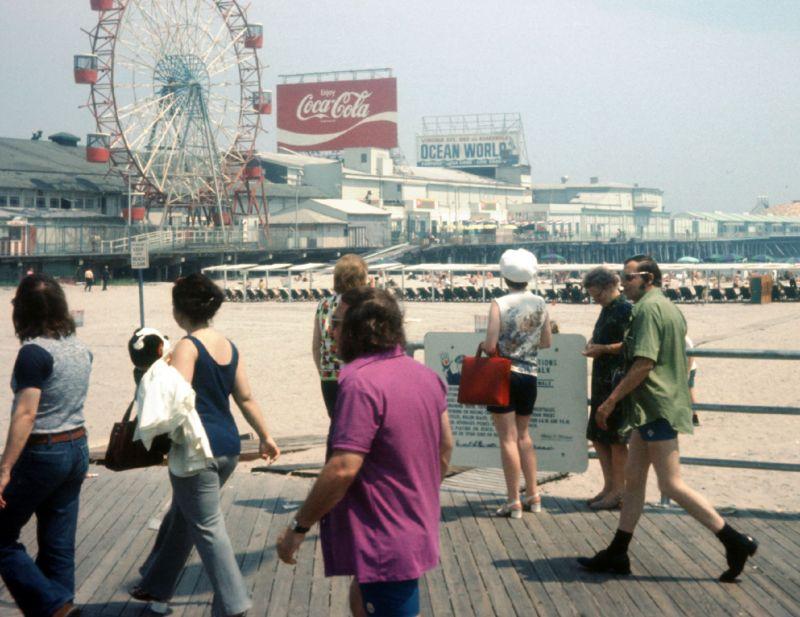
The city was, by the late 1960s, in economic free fall. White middle-class tourism had collapsed over the prior two decades, leaving cheap real estate, underutilized rooming houses, and a hospitality infrastructure with nowhere to go. Atlantic City had hotels, restaurants, entertainment venues, a beach, and a boardwalk, all the bones of a resort destination, with no resort crowd to fill them.
Into that opening stepped a queer community that now had legal permission to exist in public.
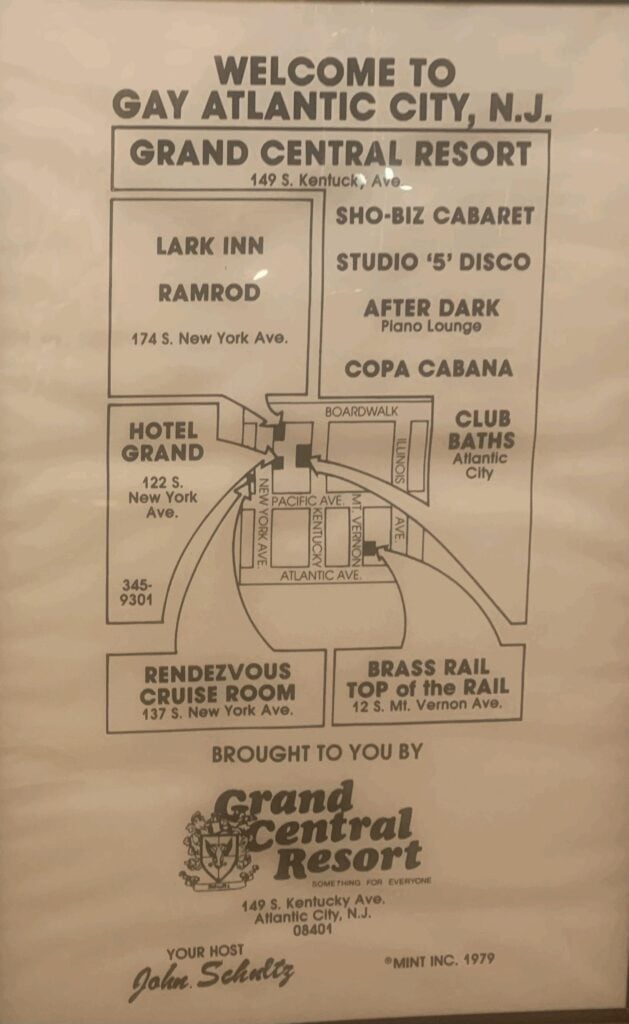
The eleven years between the One Eleven Wines ruling and the arrival of casino gambling in 1978 represent what can only be described as Atlantic City’s Golden Age — queer edition. By the early 1970s, New York Avenue and the surrounding streets held over 30 gay bars and clubs, a dozen restaurants, six or more hotels, and clothing stores catering to LGBTQ+ visitors. Snake Alley, the serpentine Westminster Place running between New York Avenue and Kentucky Avenue, was lined with rooming houses full of gay residents and guests. The Grand Central Resort, a sprawling complex of bars, a disco, a rooming house, and hotel rooms, was marketed as the largest gay hotel on the East Coast.
John Schultz, the same man who had stood behind the bar at Val’s during the ABC raids, went on to own nine gay clubs simultaneously during the height of the boom and to found the Miss’d America Pageant. He ran the Grand Central Resort and Studio 5, described by patrons as one of the biggest gay men’s bars around. He had watched the state try to erase his community. Instead, he built an empire.
Scholar Bryant Simon, whose 2002 Journal of Urban History article remains the definitive account of New York Avenue’s rise and fall, argues that Atlantic City’s economic decline created what he calls “the opportunity of emptiness” — affordable, available space where a marginalized community could build something real. What queer Atlantic City built in those eleven years was not a subculture tucked into back alleys. It was a neighborhood. It was a destination. It was a proof of concept for what LGBTQ+ community infrastructure could look like when the law got out of the way.

America’s Playground, For Everyone
Atlantic City has always been about the permission to be something you can’t be everywhere else. That’s been its promise since the first boardwalk was built, a place apart from ordinary life, where the rules are different and the night goes longer. For eleven years after a landmark legal ruling, that promise extended explicitly to queer people, and they responded by building one of the most concentrated gay neighborhoods in the country.
That spirit still carries through Atlantic City today in spaces like ByrdCage and The Hook by Spiegelworld at Caesars Atlantic City, two active LGBTQ+ friendly venues helping keep the city’s culture of nightlife, performance, and queer community alive for a new generation.
Atlantic City didn’t just host queer history. For a decade, it was the place where queer America came to be free.
That’s worth remembering.


